
New bidirectional integration brings patient-directed health information into the hands of Mobile Integrated Health and community paramedicine teams at the point of care.
Primary Record, Inc. and HealthCall, LLC today announced a formal partnership to make patients’ health information more accessible where care increasingly happens: in their homes and communities. Primary Record is a patient-directed health information platform for families and community care teams. HealthCall is an electronic health record and care coordination platform built for care delivery in Mobile Integrated Health (MIH) and Community Paramedicine (CP).
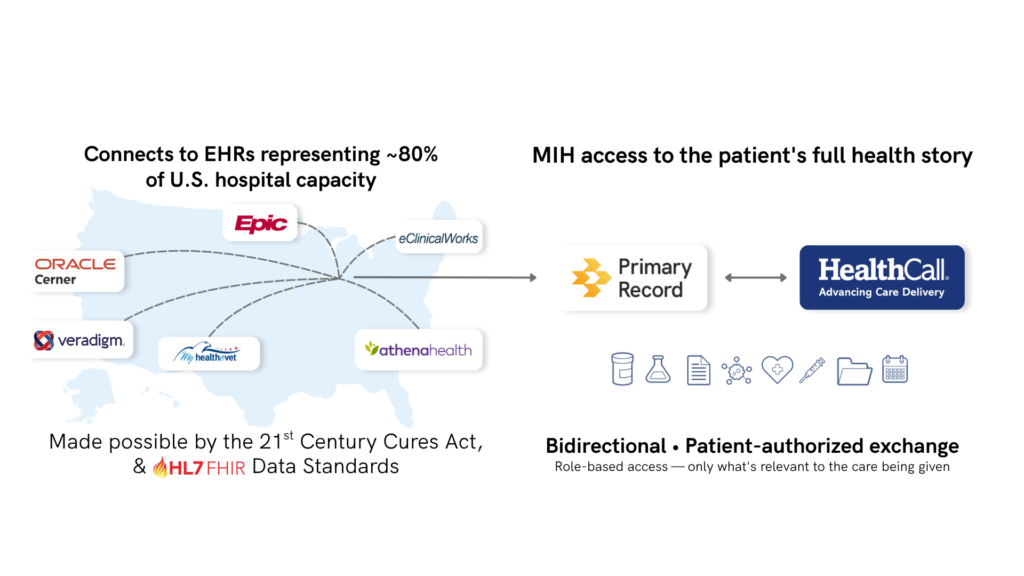
The integration connects two records: the health story patients and caregivers assemble in Primary Record, and HealthCall’s longitudinal record of MIH and community-based care. Together, they give patients, families, and authorized care professionals a more complete, current picture right when they need it most.
Putting patients in control, wherever care happens
Primary Record was built on a simple premise: patients and families often hold the only complete picture of their own care. So they deserve direct, usable access to it. Through patient-directed exchange, Primary Record already connects patients to records representing approximately 80% of U.S. hospital capacity. The 21st Century Cures Act makes this possible by giving patients the ability to direct their health data to a consumer app of their choice. This model also aligns with federal patient-access efforts led by HHS (U.S. Department of Health & Human Services) and ONC (The Office of the National Coordinator for Health Information Technology).
This partnership extends that same patient-directed model into a setting where information gaps are especially costly: the home. Community paramedics and MIH professionals often arrive with an incomplete referral. Sometimes they have little visibility into a patient’s recent hospital stay, EMS encounter, or change in condition. By connecting Primary Record’s patient-authorized record with HealthCall’s MIH encounter data, this partnership gives authorized providers meaningful context in the moment. At the same time, patients and caregivers keep control over what gets shared, and with whom.
What changes for patients, families and care teams
Patients stay in control. Patients and caregivers decide which information to share, and with whom, at the moment care happens, not before, and not by default.
Care teams get a more complete health story. MIH visits, home assessments, and community-based care now become part of the same longitudinal record that patients and caregivers already use to coordinate care across hospitals, clinics, and specialists.
Families carry a lighter burden. Because the information lives in one place, patients and caregivers spend less time logging into separate portals, tracking down records, or repeating medical histories to every new provider.
Providers deliver more informed care in the home. Authorized MIH professionals can begin an encounter with greater context about a patient’s history and current needs. As a result, they rely less on incomplete referrals or memory alone.
Patterns become visible over time. Longitudinal information helps care teams and families spot recurring events like repeated falls, frequent 911 calls, or shifts in clinical measures that are easy to miss in a single encounter. This visibility matters most for older adults, people managing multiple chronic conditions, and families coordinating care across several providers.
Leadership perspectives
“Families have become the connective tissue of a fragmented healthcare system,” said Jean Ross, MHA, BSN, RN, co-founder and CEO of Primary Record. “This partnership gives patients and caregivers a practical way to bring their health story together and share the right information with the professional standing in front of them.”
“MIH professionals often care for patients at the moment when complete context matters most, yet the information they need may be spread across several organizations and systems,” said Daniel Hayes, founder and CEO of HealthCall. “By connecting HealthCall’s longitudinal care-delivery record with Primary Record’s patient-directed record, we can help authorized providers make more informed decisions in the home.”
Building a new model for interoperability
Together, Primary Record and HealthCall are building a new model for patient-centered interoperability. Their shared goal: put relevant, actionable information directly in the hands of patients, caregivers, and authorized care professionals when it matters most. Both companies believe interoperability must reach further than data exchange among large institutions. It also needs to reach the patients, caregivers, paramedics, and community health workers delivering care outside traditional clinical settings.
This release is issued jointly with HealthCall, LLC. For more on HealthCall’s Mobile Integrated Health platform and this partnership, see HealthCall’s companion release.
About Primary Record
Based in Fishers, Indiana, Primary Record is a nurse-led, family-centered health information platform that helps patients, caregivers, and community care teams collect, organize, understand, and share health information. Primary Record brings together records and details from multiple portals and other sources so families and authorized care partners can work from a more complete, current, and understandable health story. Primary Record’s model is enabled by the 21st Century Cures Act, which gives patients the legal right to direct their health data to the app of their choice.
About HealthCall
Founded in 2003 and based in Crown Point, Indiana, HealthCall provides a care-delivery platform purpose-built for Mobile Integrated Health and Community Paramedicine. Its patient-centered platform supports longitudinal health records, flexible clinical and administrative documentation, care coordination, patient engagement, telehealth, remote monitoring, workflow automation, quality reporting, and billing-related processes. HealthCall works with first responders, healthcare organizations, and community services to support connected care in homes and other community settings.
Media Contacts
Primary Record media@primaryrecord.com
HealthCall sbruner@healthcall.com